
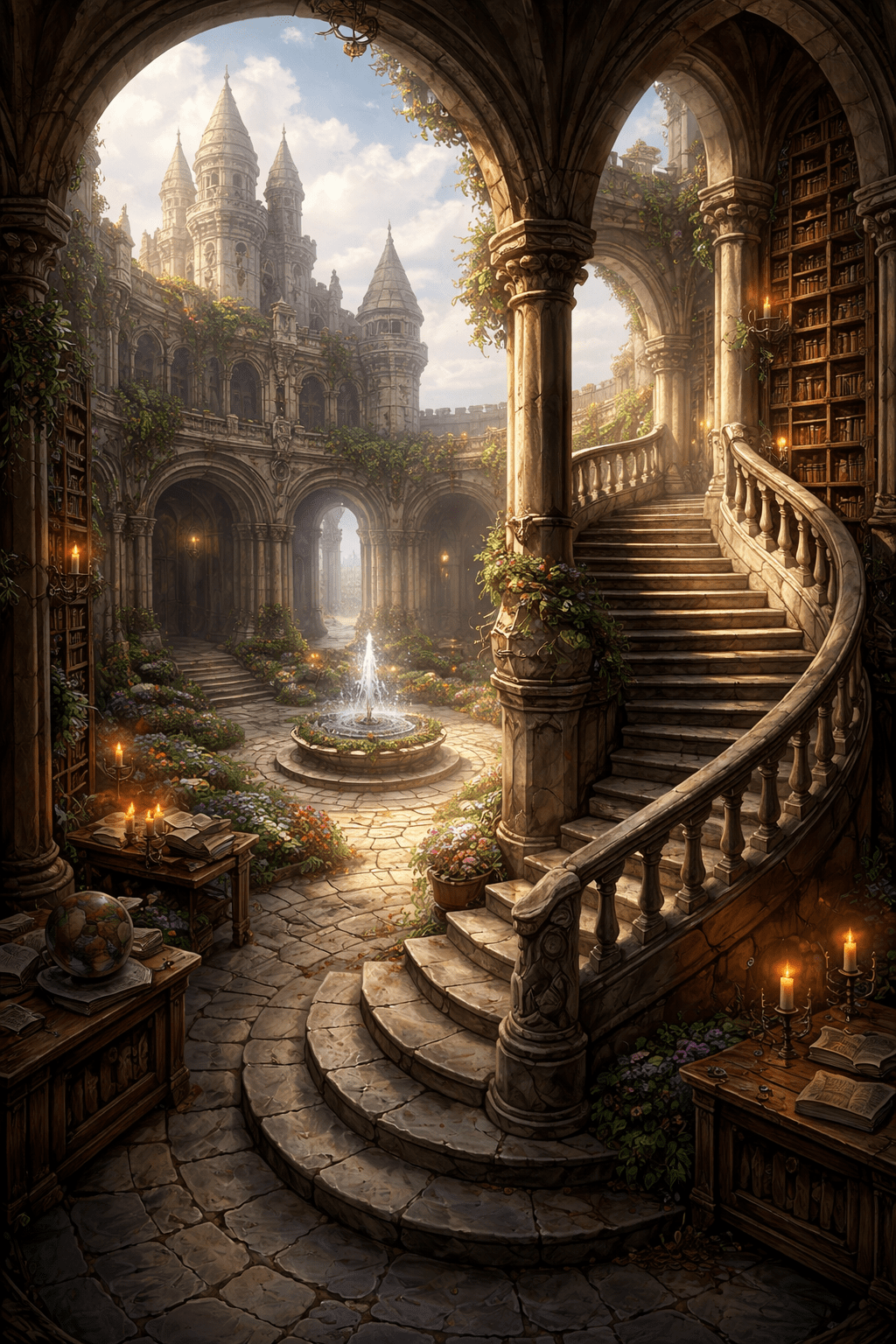
A Mind Palace (formally known as the Method of Loci) is a memory enhancement strategy that relies on spatial visualization to organize and recall information. It’s been around since Ancient Greece and Rome, but it’s seen a modern pop-culture resurgence thanks to characters like Sherlock Holmes. (psych.co)
My approach to mind palaces is a little different and more focused on the creation of your mind palace, ownership and has proven to be a powerful visualization exercise and one that can be done in between sessions and pretty much anywhere you can close your eyes for a few minutes.
The exercise starts off with taking one long breath so you are relaxed and ready to start visualizing where your mind palace is. For whatever reason the majority have theirs in a forest. We then visualize how we get there. Are you walking, flying, swimming? It’s your choice but it’s not really a choice since you are saying what comes to mind.
When I did this exercise mine was actually a mind castle with a whiteboard to the right of the entrance as you walk in. Intriguingly, I had written in green marker “personal” on the left side which was blank and “work” on the right which had a lot of indistinct writing on it. The level of detail was surprising to me as I visualized walking up the stone spiral staircase, through a thick, heavy door and into a large room containing a beautiful pool table with a green cloth in the middle.
The act of visualizing your own mind palace/ castle/ house or whatever structure comes to mind means it is yours, you have complete ownership and be a place you can go to whenever you want. It is recommended that you check on your mind palace at least once a week to make sure it is exactly the way you want it.
Sure, you can use it to remember stuff and have a filing cabinet or whatever.
Completing this exercise, ideally with your therapist since there will be processing needed, is a powerful technique
Therapeutic Purposes
The technique is used to treat a variety of conditions by transforming the way the brain organizes “mental clutter.”
• Depression & “The Hippocampus Effect”:
Research suggests that people with depression often struggle to access specific, positive memories (over-general memory). Therapists use the Mind Palace to help patients “anchor” vivid, self-affirming memories in a virtual space, making them easier to recall during a depressive episode.
• Anxiety & Emotional Regulation:
It serves as a grounding tool. By constructing a “Safe Place” palace, a person can mentally walk through a calming environment, engaging their senses to lower cortisol levels and interrupt a panic attack or spiraling thoughts.
• PTSD & Trauma Processing:
In some trauma-informed therapies, the Mind Palace helps patients “compartmentalize” intrusive thoughts. By mentally placing traumatic triggers in a “locked room” or a specific container within the palace, patients gain a sense of agency and distance from the trauma.
• Cognitive Rehabilitation:
For those dealing with early-stage dementia or brain injuries, the technique leverages the brain’s spatial navigation—one of our most robust evolutionary traits—to help maintain functional independence (e.g., remembering a grocery list or a daily medication schedule).
How it Works (Mechanics)
The reason this works so well is that our brains are naturally wired to remember places better than abstract data.
It’s a powerful tool, but it does require a bit of “mental heavy lifting” to set up initially. It is particularly effective for those who are visual learners. However, for individuals with aphantasia (the inability to visualize mental images), this specific technique may be frustrating rather than therapeutic
Interestingly, I often struggle to even get to my mind castle, getting lost on my bike. When that happens I usually just ditch the bike and use a large drone to get there. Go figure.
Have fun creating your mind palace and/ or talk to your therapist about completing this exercise.


Leave a Reply